
Retail Shop Renovation in Malaysian Malls: Step by Step
Introduction
Renovating a store inside a mall is different from renovating a shop lot on the street. The mall sets the rules, approves your drawings, controls when you can work and holds your deposit until it is satisfied. Wingspan International has delivered mall stores for brands such as Pop Mart, Swatch and Xiaomi, and most of the delays we are asked to fix start with a step that was skipped early on.
This guide sets out each stage of a retail shop renovation in Malaysia, in the order it happens, with notes on what the mall expects. If you would rather hand the whole process to one team, our retail fit-out team covers every step below, including mall submissions.
| Article Summary
A retail shop renovation in a Malaysian mall follows seven stages: brief, site survey, design, mall submission, procurement, construction and handover. Mall approval is the stage most often underestimated, so it should run in parallel with design and have buffer time built in.
|
What Are the Steps to Renovate a Retail Shop in a Malaysia Mall?
There are seven steps: agree the brief, survey the unit, develop the design, submit to mall management, procure materials, build, then hand over and reclaim your deposit. Design and mall submission overlap, and procurement starts before approval is final. Treating them as one schedule rather than separate tasks is what keeps an opening date intact.
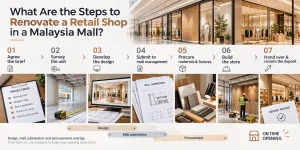
Step by Step for Retail Shop Renovation in Malaysia Malls
Step 1: Agree the brief
Write down the opening date, budget range, brand guidelines and the number of fixtures and display zones you need. Include the mall’s tenancy documents, because the lease and the tenant fit-out guidelines decide much of what is possible. A clear brief at this stage saves at least one round of redesign later.
Step 2: Survey the site
Measure the unit and record existing ceiling heights, sprinkler heads, smoke detectors, air-conditioning points, power supply and floor levels. Many mall units are handed over in a bare or partly fitted state, and the survey shows what you inherit from the previous tenant. Photographs and a measured drawing become the base for the design.
Step 3: Develop the design
The designer prepares the layout, 3D visuals and then construction drawings for walls, ceilings, lighting, electrical points and fixtures. Shop fronts usually need extra attention, because malls often control signage size, shop front materials and how far displays can sit from the lease line. Approve the 3D design before construction drawings are finalised.
Step 4: Submit to mall management
Submit the design package to the mall’s tenancy or fit-out team. Expect to provide layout plans, elevations, shop front details, a materials list, electrical and air-conditioning drawings, and contractor details. Any change to fire protection, such as moving sprinklers, may need sign-off from a qualified engineer and the Fire and Rescue Department of Malaysia (Bomba).
The mall will also ask for a renovation deposit, contractor insurance and a work permit before anyone enters the unit. Approvals typically take two to four weeks depending on the mall, and comments may need a second submission.
Step 5: Procure materials and fixtures
Order lighting, flooring, glass and display fixtures as soon as the design is fixed, not after approval arrives. Custom carpentry is usually the longest lead item. At Wingspan, counters and display units are built in our own Sungai Buloh factory, so production can start while the mall is still reviewing drawings.
Step 6: Build the store
Construction covers hoarding, partitions, ceilings, electrical and air-conditioning works, flooring, shop front, carpentry installation and signage. Most malls restrict noisy and dusty works to after trading hours, so contractors often work at night. A dedicated site supervisor keeps the mall’s building management informed and makes sure each inspection is booked on time.
Step 7: Hand over and reclaim the deposit
Before opening, the mall inspects the unit against the approved drawings and checks fire safety systems. After any defects are fixed, the store is handed over for merchandising and staff training. Keep all approval letters and as-built drawings, because the deposit refund normally depends on them.
How Long Does a Retail Shop Renovation in Malaysia Take?
A small kiosk refresh can be finished in under three weeks, while a full flagship store usually takes two to three months from brief to opening. For a typical mall unit, construction alone often takes three to four weeks. The total depends on unit size, custom carpentry and how quickly the mall processes approvals.
The table below shows the typical duration of each stage. Several stages overlap, so the total is shorter than the sum.
| Stage | Typical duration | Can overlap with |
|---|---|---|
| Brief and site survey | 3 to 5 working days | None |
| Design development and revisions | 1 to 2 weeks | Mall submission preparation |
| Mall management approval | 2 to 4 weeks | Design finalisation, procurement |
| Procurement and carpentry production | 2 to 4 weeks | Mall approval |
| Construction and fit-out | 3 to 6 weeks | Final carpentry delivery |
| Inspection and handover | 3 to 5 working days | None |
For a fuller breakdown, see our article on how long a retail fit-out takes in Malaysia.
What Should You Know About Renovating in Major Malaysian Malls?
Each mall publishes its own fit-out guidelines, and the details differ: submission format, working hours, deposit amount and inspection steps. The notes below come from our own projects in these malls. Always confirm current rules with the mall’s tenancy team, because guidelines are updated from time to time.
- Pavilion Bukit Jalil: we renovated the Pop Mart store here. Finalise shop front and signage details early, because frontage is usually reviewed closely in premium malls.
- Mid Valley Southkey, Johor Bahru: our Swatch store here was a compact unit, so in-house carpentry helped us fit display and storage into a small floor area.
- IOI City Mall: a large mall with many tenants renovating at any time, so book inspection slots early in the programme.
- The Exchange TRX: our Xiaomi and MyNews projects here were in one of Kuala Lumpur’s newest malls, so expect detailed submission requirements.
How Is a Mall Store Renovation Different From a Shop Lot Renovation?
A shop lot renovation is mainly governed by the local council and the building owner, while a mall store renovation must also satisfy the mall’s own fit-out rules. Malls add design approval, deposits, insurance and working-hour limits. Shop lots give more freedom over hours and frontage but may need council permits for façade or structural changes.
| Factor | Mall store | Shop lot |
|---|---|---|
| Main approver | Mall management, plus authorities where needed | Local council and landlord |
| Working hours | Usually after trading hours | Usually daytime, subject to council rules |
| Deposit and insurance | Required by the mall | Depends on landlord |
| Shop front and signage | Controlled by mall guidelines | Council signage permit |
| Typical timeline driver | Mall approval period | Council permits and structural works |
FAQ
How much does it cost to renovate a retail shop in a mall?
The cost depends on unit size, the condition of the unit at handover, shop front design and how much custom carpentry is involved. Brands also need to budget for the mall’s renovation deposit, insurance and any fees for services such as fire system modification. A quote broken down by trade makes it easier to compare contractors fairly.
Who handles mall approvals during a store renovation?
The tenant is responsible for getting approval, but most brands appoint their fit-out contractor to prepare and submit the drawings. A contractor experienced with the mall knows its submission format and the comments it usually gives. At Wingspan, mall submissions are handled by the same team that builds the store, so feedback goes straight into the construction plan.
Can a retail renovation contractor work during mall opening hours?
Light, quiet tasks inside a closed hoarding may be allowed during the day, but drilling, cutting, painting and deliveries are normally limited to after trading hours. Each mall sets its own rules. Night work affects labour cost and programme, so ask your contractor how its quote accounts for the mall’s working hours.
What documents does a mall ask for before a renovation starts?
Malls typically ask for approved design drawings, electrical and air-conditioning drawings, a method statement, the contractor’s company details, workers’ details, insurance certificates and the renovation deposit. Some also ask for a safety plan and a programme of works. Requirements vary, so request the mall’s fit-out manual at the lease stage.
How do brands keep stores consistent when renovating outlets in several malls?
Consistency comes from standard drawings, fixed material specifications and one contractor producing the fixtures. Brands rolling out several stores benefit from a contractor that builds its own carpentry, because finishes and dimensions stay the same from one mall to the next. That is one reason 85% of Wingspan’s clients continue working with us across multiple outlets.
Conclusion
A mall store renovation runs smoothly when design, mall approval and procurement are planned as one programme, with buffer time for approvals and a site supervisor who keeps the mall informed. Wingspan International handles each of the seven steps with one team, from the first site survey to the final inspection, and builds counters and fixtures in our own factory.
Planning a new store or a refresh in a Malaysian mall? Speak to our team about your opening date and we will map out a realistic programme.